how DIAMON-FUSION® NANO-TECHNOLOGY works
DFI's nanotechnology, patented in the US and branded under the Diamon-Fusion® trademark, uses a two-stage chemical process.
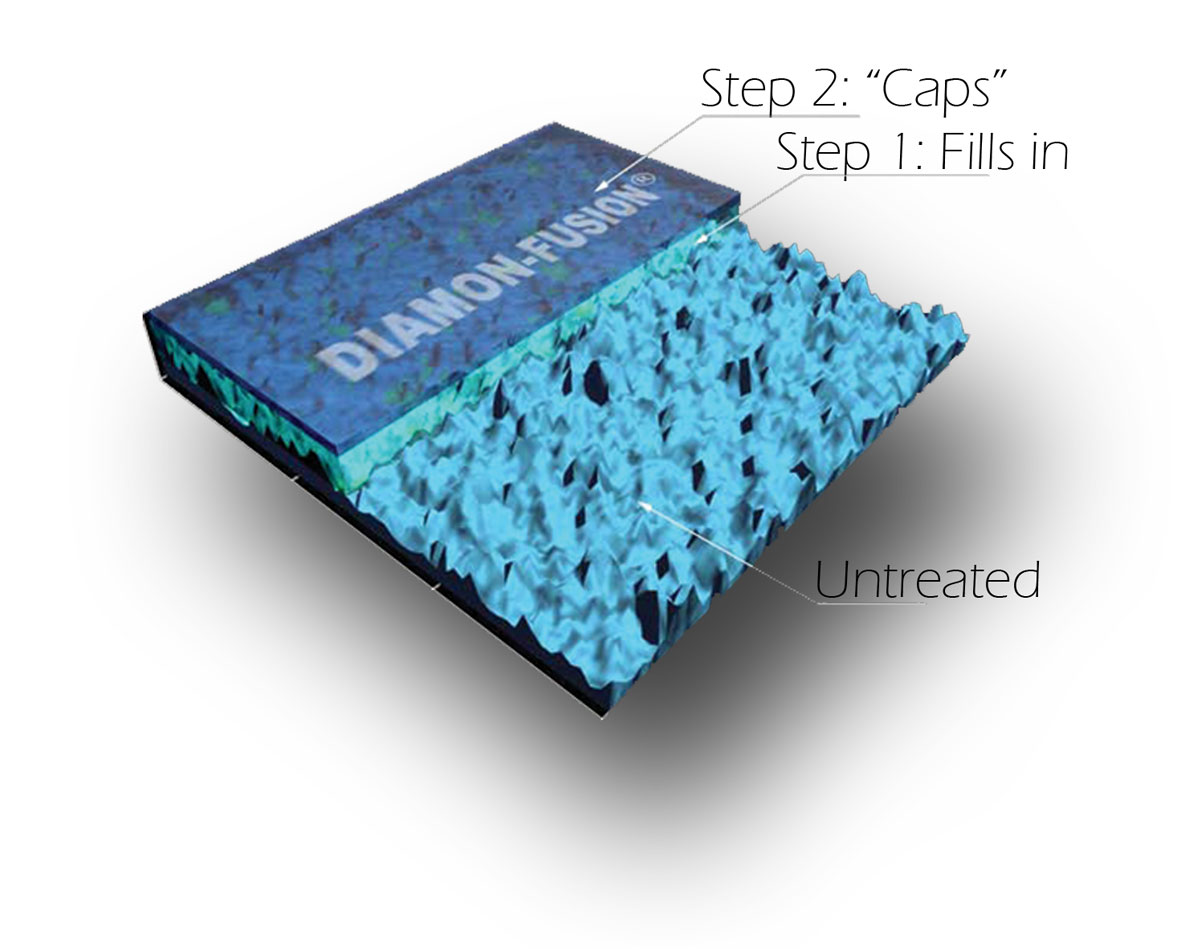
The chemical reaction created in the first stage causes a "cross-linked" and "branched" ultra thin silicone film (nanofilm) to be grown from below the surface out.
The second stage 'caps' the entire chain of atoms. This unique 'capping' substantially increases the hydrophobicity and durability, leaving, chemically speaking, no points of attachment for contaminants and creating a truly repellant charge.
Through simple neutralization, all chemicals become inert within a few seconds. No curing time is needed since the chemical reaction itself occurs in less than 2 seconds.
DFI’s NANO-CHEMISTRY
The chemical reaction bonds to form an ultra-thin protective layer of optically clear durable material, a nanostructurated device, making the surface significantly easier to clean and more resistant to weathering. This method is done at nano-scale levels, thus also called ‘nano-chemistry’, which is a length scale of approximately 1 – 100 nanometer range (1 nanometer is 1/1,000,000,000 meter, or 1 billionth of a meter). Nanometer dimensions are at the atomic dimension scale.
DFI’s COVALENT BOND
The bond created in the patented process is a covalent bond, the strongest possible bond, in chemical terms that a hydrophobic coating can generate. A covalent bond means that the coating shares the electrons within the glass itself, thus becoming a part of the glass. Covalent Bonds are approximately 10 times stronger than hydrogen-bridge bonds, which are commonly present in most other water repellent coatings.
DIAMON-FUSION® TEST RESULTS
The following are test results from Dr. William C. LaCourse , Professor of Glass Science at the Institute for Glass Science and Engineering at Alfred University, New York, an independent testing laboratory. Dr. LaCourse is an expert in the study of glass and ceramics. He has done testing for major companies like PPG and Kohler. Below is a summary of the most important findings of his tests.
Dr. LaCourse states in his reports that our improved process has a remarkably low coefficient of friction when the glass is wet. He states that when glass is wet, it is by far the "most dangerous period" with regards to the potential for damage. The report says that "we believe that the (main) usefulness of your coating lies in its maintenance of a low friction coating over the life of the glass". Below is a formula that puts into layman's terms the results of the coefficient of friction tests.
WATER REPELLENCY - Contact Angle
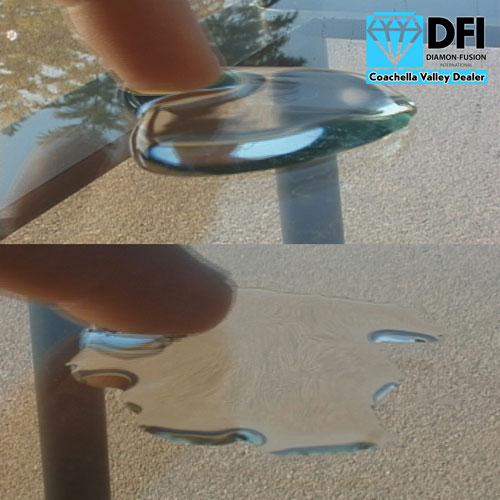
Contact angle is the scientific method of measuring the water repellency of a surface. The higher the number, the higher the water repellency of the surface.
| Material | Angle |
| Untreated Glass | 14° |
| Improved Diamon-Fusion® | 118° |
| Our main competitor | 91° |
| Untreated Glass | 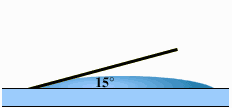 |
| Treated with DF1 | 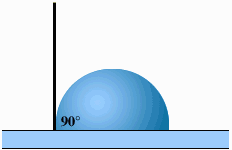 |
| Treated with DF2 | 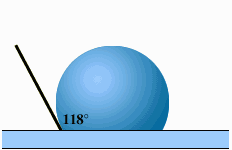 |
IMPACT and SCRATCH RESISTANCE: Coefficient of Friction
| Material | µ |
| Untreatred Glass | 0.82 |
| Improved Diamon-Fusion® | 0.13 |
To make the test results for coefficient of friction useful, we have used a formula that translates the data into the force required to cause damage to the surface. Assume that a load of 10 lbs. has been placed on the rider under static conditions, and that this is the lowest load that caused cracking (no dragging). Using the formula we can now calculate the load that would cause cracking to occur when the rider is dragged across the sample.
| Material | Load (lbs) |
| Untreatred Glass | 0.37 |
| Improved Diamon-Fusion® | 4.00 |
Note that when comparing wet vs. wet friction calculations indicate that it would take more than 11.76 times the load (4.0 lbs. vs. 0.37 lbs.) to cause damage on your treated sample vs. the untreated.
In other words, the weight of a debris particle required to crack a piece of glass that has been treated with Diamon-Fusion® would need to be ten times heavier than the weight required to crack an untreated piece of glass.
Reduces rock-chip damage caused by propelled road debris
Makes glass 10x harder to scratch